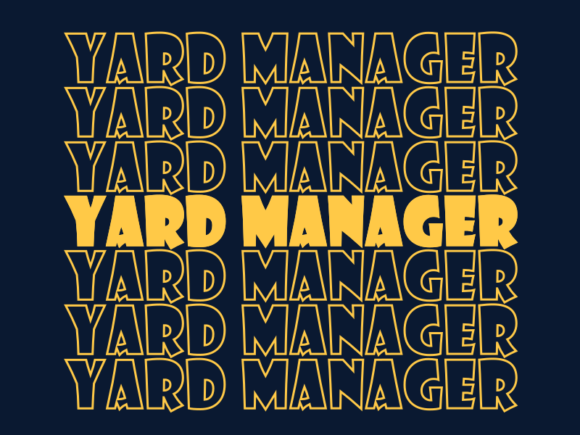
Yard Manager SVG Cut File: A Strategic Asset for Precision Craft and Professional Design
A Yard Manager SVG Cut File is more than a decorative graphic—it’s a purpose-built, resolution-independent vector asset engineered for adaptability, consistency, and operational efficiency. As a scalable vector graphic (SVG), it retains crisp clarity at any size—from a 1-inch badge to a 6-foot banner—without distortion, aliasing, or pixelation. This technical reliability translates directly into strategic advantage when applied intentionally across physical and digital workflows.
Why Scalability Matters Beyond Aesthetics
Scalability isn’t just about resizing—it’s about reducing decision fatigue and eliminating rework. When you use a Yard Manager SVG Cut File, you’re not committing to one fixed dimension or material. You’re securing flexibility: the same file can guide a Cricut Maker cutting vinyl for fleet signage, a Silhouette Cameo scoring kraft paper for workshop labels, or a laser engraver etching onto leather-bound binders for client deliverables. That means fewer file conversions, no quality compromises during iteration, and faster turnaround from concept to physical output.
This matters most when timelines are tight or consistency is non-negotiable—think branded event kits for a logistics conference, classroom visual aids that must scale for both desk reference and wall display, or custom safety tags for yard equipment where legibility at 3 feet is as critical as readability at 12 inches.
Strategic Use Cases Across Roles and Outcomes
Different goals demand different applications—and the Yard Manager SVG Cut File supports them all without requiring new design work each time:
- Small business owners use it to produce durable, on-brand signage for loading docks, storage zones, and inspection areas—reducing reliance on third-party printers and enabling rapid updates when layout changes.
- Educators and trainers deploy it in hands-on operations simulations, cutting out laminated role-play cards or scaled site maps for logistics curriculum—supporting tactile learning while maintaining visual fidelity across student groups.
- Marketing and communications teams integrate it into campaign collateral: die-cut stickers for promotional mailers, layered vinyl decals for trade show booths, or embossed textile patches for branded apparel—all sourced from a single, editable vector file.
- Operations managers apply it to internal process improvement—generating color-coded floor markers, equipment ID tags, or SOP flowcharts printed on weather-resistant materials for outdoor yard use.
Each application hinges not on novelty, but on alignment: Does this Yard Manager SVG Cut File serve a documented need? Does it reduce friction in an existing workflow—or create unnecessary complexity?
What to Consider Before Cutting—Not Just What to Cut
Before importing the Yard Manager SVG Cut File into your machine software, pause to assess three practical dimensions:
- Material compatibility: Not all cutters handle every substrate equally. Vinyl and cardstock respond predictably; thicker leather or textured felt may require test passes, adjusted blade depth, or slower speed settings. Review your machine’s specifications—not just the file’s capabilities.
- Color and layer logic: SVG files often contain grouped elements with embedded color assignments. If your project requires multi-material layering (e.g., white base + colored overlay), verify how layers are structured and whether your software preserves fill/stroke relationships during import.
- Contextual accuracy: A well-designed Yard Manager SVG Cut File includes clear labeling, consistent scale indicators, and intentional negative space. Check that text remains legible at your target size, and that icons or symbols align with industry conventions—especially if used for safety, compliance, or wayfinding.
Skipping these checks invites rework—not because the file is flawed, but because execution wasn’t calibrated to outcome.
Intentional Customization, Not Random Adjustment
You can change colors, rearrange elements, or combine the Yard Manager SVG Cut File with other assets—but do so with purpose. Ask: What does this modification achieve operationally? For example:
- Swapping blue for high-visibility orange improves hazard zone identification—not just because it “looks bolder.”
- Adding a QR code beside a yard map element links physical signage to real-time inventory dashboards—extending utility beyond static display.
- Removing decorative borders streamlines production time and reduces material waste on high-volume label runs.
Every edit should trace back to a measurable objective: faster orientation, clearer accountability, reduced error rate, or stronger brand recognition. Random customization dilutes impact and weakens recall—especially in environments where visual consistency supports procedural adherence.
Risks of Context-Free Use
A Yard Manager SVG Cut File used without goal alignment becomes decoration—not utility. Common missteps include:
- Applying intricate designs to low-resolution substrates (e.g., coarse burlap), where fine details vanish upon cutting.
- Scaling complex layouts beyond a machine’s tolerance—causing misalignment, incomplete cuts, or excessive wear on blades.
- Using generic iconography in safety-critical areas where standardized symbols (like ISO 7010) are required by regulation.
These aren’t failures of the file—they’re symptoms of applying a precise tool without situational awareness. The highest-value users don’t treat the Yard Manager SVG Cut File as a shortcut. They treat it as infrastructure: something audited, tested, and refined alongside process documentation and team training.
Long-Term Value Lies in Reusability and System Integration
The real ROI emerges over time—not per project, but per system. When the Yard Manager SVG Cut File is stored with version control, linked to standard operating procedures, and paired with material guides and machine presets, it evolves from a one-off download into a maintained asset. Teams begin referencing it during onboarding. Designers build templates around its grid structure. Operations leads update it quarterly to reflect facility changes—knowing every revision propagates cleanly across outputs.
This level of integration doesn’t happen automatically. It requires documenting usage rules, archiving test results (e.g., “Works at 120% scale on Oracal 651 vinyl with Cricut AutoBlade”), and assigning ownership—not of the file itself, but of its ongoing relevance.
Final Thought: Precision Demands Intention
A Yard Manager SVG Cut File delivers what you prepare it to deliver. Its scalability, versatility, and editability are powerful—but only when anchored in clarity of purpose. Whether you’re labeling equipment, reinforcing training concepts, launching a service line, or upgrading facility communication, let the file serve your strategy—not define it. Choose it because it solves a defined problem, fits within your operational constraints, and strengthens consistency across touchpoints. Then cut—not just with your machine, but with confidence.