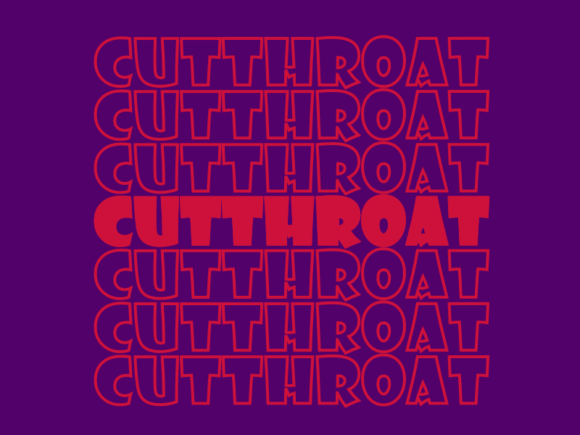
Cutthroat SVG Cut File: Precision, Versatility, and Future-Ready Craftsmanship
At the intersection of digital design and hands-on making lies a quietly transformative tool: the Cutthroat SVG cut file. Unlike raster images—JPEGs or PNGs that blur or pixelate when enlarged—this is a Scalable Vector SVG Graphic, built from mathematical paths rather than fixed pixels. That foundational distinction unlocks consistent clarity across scales, materials, and machines—making it indispensable for creators who demand fidelity without compromise.
Why Scalability Isn’t Just a Feature—It’s a Workflow Revolution
When you scale a JPEG logo from business card size to a 48-inch trade show banner, edges soften, text becomes illegible, and detail dissolves. An SVG avoids this entirely. Because it stores shapes as coordinates, curves, and strokes—not grids of color—the Cutthroat SVG cut file renders flawlessly whether sized to 0.5 inches for a charm pendant or 36 inches for a wall decal. No resampling. No interpolation. No guesswork.
This isn’t theoretical convenience—it reshapes real-world production. A classroom teacher can import one SVG into Cricut Design Space, resize it to fit a student’s notebook cover, then re-export the same file at double scale for a bulletin board display—all without opening a new editor or adjusting layers. A small-batch apparel brand can use the identical vector asset for embroidery digitizing (converted via compatible software), heat-transfer vinyl cutting, and screen-print film output—each requiring different dimensions but sharing the same underlying geometry.
Material Agnosticism: From Paper to Leather and Beyond
The adaptability of the Cutthroat SVG cut file extends far beyond dimension. Its vector nature makes it inherently material-flexible—provided your cutting machine supports the substrate. Modern digital cutters like the Silhouette Cameo 4, Cricut Maker 3, or Brother ScanNCut DX recognize vector paths as precise blade instructions. That means:
- Vinyl: Ideal for decals, window graphics, and vehicle wraps—SVG paths translate directly to clean, weeding-friendly outlines.
- Felt and cotton fabric: When paired with rotary blades or fabric-specific mats, SVGs enable intricate appliqué templates, quilt labels, or textile stencils—no tracing, no distortion.
- Leather and faux leather: With appropriate pressure and blade depth, SVGs guide precise cuts for keychains, journal covers, or artisanal accessories—retaining fine line work even on textured surfaces.
- Cardstock, chipboard, and balsa wood: For layered paper crafts, shadow boxes, or architectural models, SVGs ensure registration accuracy across multiple passes and thicknesses.
Crucially, none of these applications require separate file versions. One Cutthroat SVG cut file serves them all—reducing version sprawl, minimizing storage overhead, and eliminating conversion errors that plague raster-to-vector tracing workflows.
Color Customization Without Compromise
Unlike static image files locked in RGB or CMYK, SVGs store color as editable attributes—meaning every stroke and fill is modifiable in seconds. Within most cutting software or vector editors (like Inkscape or Adobe Illustrator), users can:
- Swap a navy blue outline to metallic gold for holiday-themed ornaments.
- Apply gradient fills to simulate watercolor washes before cutting water-soluble stabilizer for embroidery.
- Isolate individual components—such as petals in a floral motif—to assign distinct colors for multi-material layering (e.g., green felt leaves + red vinyl berries).
- Use global swatches to update color schemes across dozens of related designs simultaneously—a time-saver for educators building themed lesson kits or marketers launching seasonal campaigns.
This flexibility supports accessibility too: high-contrast color variants can be generated instantly for students with visual processing differences, and monochrome versions remain crisp for black-and-white printing or laser engraving previews.
Real-World Applications Across Diverse Domains
The utility of the Cutthroat SVG cut file emerges most clearly when mapped to concrete roles and outcomes—not abstract categories.
Educators and Curriculum Designers
In elementary classrooms, SVGs power tactile learning tools: alphabet tiles cut from magnetic sheeting, continent-shaped puzzles from foam board, or Braille-labeled science diagrams. Because teachers often lack graphic design training, the plug-and-play compatibility of SVGs with free platforms like Cricut Design Space lowers the barrier to creating custom manipulatives—without outsourcing or licensing fees.
Small Business Owners and Makers
A local bakery uses the same Cutthroat SVG cut file for three distinct purposes: die-cut cupcake toppers (cardstock), reusable acrylic cake stand inserts (laser-cut), and embroidered napkin monograms (converted to PES format). This cross-platform reuse compresses product development cycles and ensures brand consistency—from packaging to point-of-sale signage.
Graphic Designers and Brand Strategists
Designers embed SVGs directly into responsive websites, Figma prototypes, or PDF presentations—where they retain sharpness on retina displays and print outputs. When clients request branded merchandise mockups, designers pull the original SVG into mockup generators, adjust colors to match Pantone references, and deliver photorealistic visuals—no upscaling artifacts, no client confusion over “low-res previews.”
Hobbyists and Mixed-Media Artists
An artist combining resin casting and laser etching imports the Cutthroat SVG cut file into LightBurn software, adjusts kerf compensation for acrylic thickness, then exports a nested layout to minimize material waste. Later, the same file becomes a stencil for hand-painted ceramic tiles—scaled down and printed on freezer paper. The vector backbone bridges analog and digital steps seamlessly.
Technical Considerations That Impact Real Use
While SVGs offer exceptional versatility, effectiveness depends on thoughtful implementation:
- Path simplicity matters: Overly complex nodes or embedded raster elements (common in poorly optimized downloads) cause cutting delays or misreads. Reputable Cutthroat SVG cut file providers simplify paths, merge overlapping shapes, and avoid unnecessary compound paths.
- Machine-specific optimization: Some cutters interpret open paths differently than closed ones. Files intended for intricate weeding—like lace patterns—benefit from outlined strokes and converted text, ensuring every element is a cuttable shape, not just a visual instruction.
- Layer organization enhances control: Well-structured SVGs separate cut lines, score lines, and print-then-cut registration marks into named layers. This lets users toggle visibility, assign different blade settings per layer, or isolate components for partial cutting.
- Licensing clarity prevents friction: Commercial-use rights vary widely. Creators deploying SVGs for client work, resale products, or public installations must verify license scope—especially regarding derivative works, digital redistribution, or SaaS platform integration.
Looking Ahead: SVGs in an Evolving Creative Ecosystem
As generative AI tools increasingly produce vector-ready outputs—and as browser-based design platforms deepen SVG support—the Cutthroat SVG cut file is becoming more than a craft staple. It’s evolving into a lingua franca for interoperability: bridging AI prompt engineering with physical output, enabling collaborative design reviews with live-editable assets, and supporting modular design systems where components scale, recolor, and recombine without loss.
For researchers studying maker pedagogy, SVG metadata offers traceable provenance—recording authorship, modification history, and material assignments. For sustainability-focused makers, SVG nesting algorithms reduce scrap by up to 22% compared to manual layout, turning efficiency into environmental impact.
Ultimately, the enduring value of the Cutthroat SVG cut file lies not in novelty, but in quiet reliability. It doesn’t shout. It delivers. Whether you’re etching a name onto a child’s wooden toy, prototyping a wearable tech enclosure, or producing 500 branded tote bags for a nonprofit gala—the same vector file anchors every step. No quality debt. No format fatigue. Just precision, ready when you are.