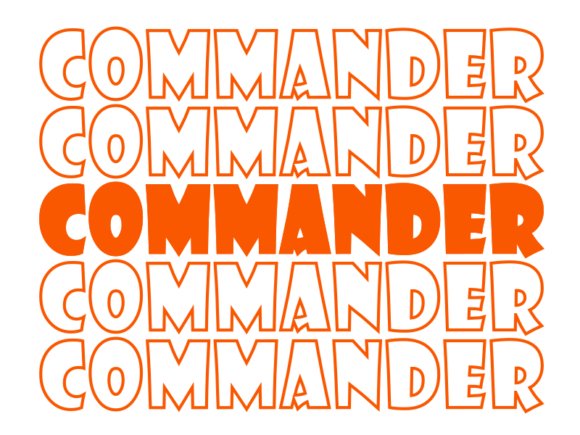
Commander SVG Cut File: Precision, Flexibility, and Future-Ready Craftsmanship
At the intersection of digital design and hands-on making lies a quietly transformative tool: the Commander SVG cut file. More than just a downloadable graphic, it represents a shift in how creators—from classroom teachers to boutique brand owners—approach physical production. Built as a scalable vector SVG graphic, it preserves crispness at any dimension, eliminates pixelation under zoom or enlargement, and adapts seamlessly across materials and machines. This isn’t theoretical flexibility—it’s operational reliability, grounded in the mathematical precision of vector paths.
Why Scalability Isn’t Just a Feature—It’s a Workflow Foundation
Unlike raster images (JPEGs, PNGs), which rely on fixed grids of pixels, SVGs describe shapes using coordinates, curves, and strokes. That means when you scale a Commander SVG cut file from a 2-inch sticker to a 36-inch wall decal, the lines remain razor-sharp—not blurry, not jagged, not re-rendered. There’s no loss, no interpolation, no guesswork. This fidelity matters profoundly in real-world contexts: a teacher printing identical lettering for twenty student name tags needs consistency; a small-batch apparel designer resizing a monogram for both tote bags and cufflinks requires exact proportion retention; an event planner layering intricate floral motifs across banners, napkin wraps, and acrylic place cards depends on uniform line weight and spacing at every scale.
The scalability extends beyond size—it applies to complexity too. A single Commander SVG cut file may contain nested layers, grouped elements, and color-coded paths that correspond directly to cutting mats or material types. When imported into software like Silhouette Studio or Cricut Design Space, those vectors translate cleanly into machine-executable instructions—no manual redrawing, no tolerance drift, no “fixing” required before cutting.
Material Agnosticism: From Paper to Leather, Felt to Fabric
One of the most underappreciated strengths of Commander SVG cut files is their material neutrality. Because they define *what* to cut—not *how* to render—the same file serves equally well for:
- Paper & cardstock—for layered greeting cards, pop-up book elements, or classroom manipulatives;
- Vinyl (permanent, removable, heat-transfer)—for vehicle decals, laptop skins, or custom apparel;
- Felt and leather—for tactile learning tools, jewelry components, or artisanal home décor accents;
- Cotton, linen, and denim—when paired with compatible rotary cutters or embroidery-ready hybrid workflows;
- Thin acrylic, balsa wood, and chipboard—for architectural models, packaging prototypes, or dimensional signage.
This versatility stems from how digital cutting machines interpret vector data: they follow path directions, honor closed shapes for weeding or removal, and respect stroke attributes like “cut,” “score,” or “draw.” The Commander SVG cut file doesn’t encode material physics—but it provides the unambiguous geometry that lets your machine apply its own material-specific settings (blade depth, speed, pressure) without ambiguity.
Color Customization as Creative Control—Not Just Decoration
SVG is inherently style-aware. Within the file’s code, fill colors, stroke weights, and opacity values are editable parameters—not baked-in pixels. That means you’re never locked into someone else’s palette. A wedding planner can adjust hex values to match Pantone 12-0709 TCX (a soft sage green) across all invitation elements. An educator designing a bilingual phonics chart can assign distinct colors to consonant clusters and vowel teams—then export variants for print, projection, and tactile overlays—all from the same base Commander SVG cut file.
More importantly, color changes don’t affect cut behavior unless intentionally linked. You can set a red stroke for visibility during design, then switch it to “no stroke” before sending to the machine—or assign different colors to different layers so your Cricut automatically loads corresponding tools (e.g., red = fine-point blade, blue = scoring wheel). That separation between visual guidance and mechanical instruction gives users granular control without technical overhead.
Diverse Applications Across Sectors—Rooted in Shared Principles
The reach of Commander SVG cut files spans disciplines precisely because their core traits—resolution independence, material adaptability, and editable structure—solve universal challenges:
Educators and Curriculum Developers
In classrooms, time is finite and differentiation is essential. A single Commander SVG cut file for geometric shape sets can generate manipulatives in varying sizes (for kinesthetic learners), high-contrast versions (for visual accessibility), and tactile variants (with embossed edges or fabric backing)—all without redesigning from scratch. Teachers report cutting prep time dropping by 60–75% when swapping static PDF templates for editable SVG assets.
Small Business Owners and Makers
For Etsy sellers, local gift shops, or micro-brands, consistency across touchpoints is non-negotiable. A logo saved as a Commander SVG cut file ensures identical rendering on business cards, embroidered patches, laser-engraved coasters, and Instagram story graphics. No version drift. No vendor miscommunication. No last-minute “Can you make this bigger?” panic. It becomes the single source of truth for physical and digital identity.
Event Planners and Wedding Designers
Customization at scale defines modern event aesthetics—and SVGs deliver it. Floral monograms cut from ivory vinyl for ceremony backdrops reappear as gold-foiled motifs on menus and silver-etched patterns on glassware. Because each iteration uses the same vector skeleton, alignment across formats remains perfect. Even dynamic elements—like place cards with variable guest names—can be generated programmatically via SVG templating engines, merging personalization with structural integrity.
Graphic Designers and Brand Strategists
Professionals increasingly embed production-readiness into early-stage design. Rather than handing off final artwork to a third-party cutter, designers now build with SVG-native constraints: avoiding tiny interior cuts that jam blades, respecting minimum stroke widths for material thickness, and labeling layers for multi-step assembly. Commander SVG cut files serve as living design systems—tested, documented, and ready for fabrication the moment a client approves.
Practical Considerations for Real-World Use
While powerful, Commander SVG cut files perform best when used with awareness—not just convenience. Three considerations stand out:
- Software Compatibility Matters: Not all SVG parsers handle advanced features (clipping paths, embedded fonts, complex gradients) identically. For guaranteed results, simplify fills to solid colors, convert text to outlines before exporting, and verify layer naming conventions align with your machine’s import logic.
- Machine Capabilities Dictate Output—Not the File: A Commander SVG cut file won’t compensate for hardware limits. If your Cricut Explore Air 2 lacks a rotary blade, it won’t cut woven fabric—even if the SVG is perfectly structured. Always match file complexity to your tool’s physical range.
- Licensing Clarity Is Non-Negotiable: Commercial use rights vary widely. Some Commander SVG cut files permit unlimited physical products but prohibit resale of the digital file itself; others restrict use to personal projects only. Always review license terms before scaling production—or integrating into client deliverables.
Looking Ahead: Where Vector Craftsmanship Is Headed
The evolution of Commander SVG cut files mirrors broader shifts in creative technology: toward interoperability, sustainability, and intelligence. We’re seeing tighter integration with AI-assisted design tools that suggest optimal nesting layouts to reduce material waste; browser-based editors that preview cut paths in real time across simulated materials; and cloud libraries where educators share curriculum-aligned SVG kits vetted for classroom durability and pedagogical intent.
What remains constant is the foundational advantage: a Commander SVG cut file doesn’t age. It doesn’t degrade. It doesn’t require reformatting for next-generation machines. Its value compounds over time—not through novelty, but through reliability, reuse, and reinterpretation. Whether you’re etching a quote onto reclaimed wood for a coffee shop wall or laser-cutting Braille labels for a public library exhibit, the vector path stays true. And in an era of fleeting trends and disposable content, that kind of permanence isn’t just practical—it’s quietly revolutionary.